Derivative Markets
The participants or players in the derivatives markets can be banks, foreign institutional investors, corporates, brokers, individuals, etc. All of them can be classified into four depending on their motives. They are hedgers, speculators, arbitrageurs, and spreaders. They have different motives.
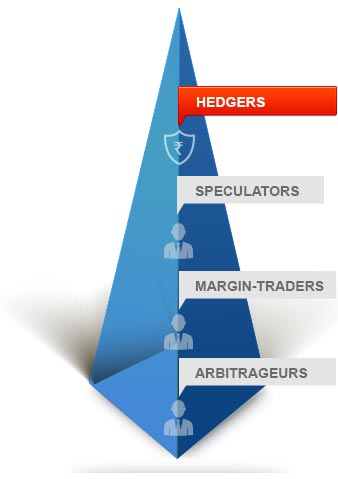
Hedgers: As already stated, hedging (covering against losses) is the prime reason which led to the emergence of derivatives. (Hedgers are those who enter into a derivative contract to cover the risk the motive of hedgers is not to make a profit but to reduce or eliminate risk. Thus, hedgers use derivatives to reduce or eliminate the risk associated with the price of an asset in the market. Take an example farmer growing wheat faces uncertainty about the price of his produce at the time of the harvest. Similarly, a flour mill needing wheat also faces uncertainty regarding the price of wheat. Both the farmer and flour mill owner can enter into a forward contract in this contract, the farmer agrees to sell his produce when harvested at a predetermined price to the flour mill. The farmer fears price fall while the flour mill owner fears price rise Both the parties face price risk. A forward contract would eliminate price risk for both parties. A forward contract is entered into with the objective of hedging against the price risk being faced by the farmer as well as the flour mill owner. Such participants in the derivative markets are called hedgers. In the example, the contract would be settled by the farmer delivering the wheat to the flour mill on the agreed date at an agreed price.
Functions of Hedgers: Important functions of hedgers may be outlined below
(a) To eliminate the price risk of contracting parties.
(b) To help to increase the trading volume.
(c) To attract more people into the derivatives market.
2 Speculators: Speculators are those who are willing to take risks. They take risks to make a profit from price fluctuations. Thus their main motive is to make money out of the risks assuming they accept risks in the expectation of a return. They forecast the future economic conditions. After this, they decide the position (long or short) to be taken that will yield a profit if the forecast is realized. They make forecasts about the prices and put their money in these forecasts. By taking positions, they are betting that a price would go up or they are betting that it would go down. Depending on their perceptions they may take long or short positions (this will be discussed later). Thus, their objective is to gain when the prices move as per their expectation. Let us take an example: The forward price in US dollars for a contract maturing in three months is 70 tone believes that three months later the price of US dollars would be 72, one would buy forward today and sell later from such a contract one can make a profit of 2 per dollar. On the contrary, if one believes the US dollar would depreciate to TGB in O month he would sell now and buy later Here, the actual delivery of the underlying e actual buying and selling) does not take place instead, the speculator gains from tw differential in price Speculation is a double-edged sword in means that there is a possibility of making a profit (if the prediction is correct) or incurring a loss (if the prediction is incorrect.
There are three types of speculators
Based on duration (a) Scalpers (hold for a very short time-in minute).
(b) Day traders (one trading day).
(c) Position traders (long period week, month a year).
Speculators perform an extremely important function. They provide liquidity to the market Without speculators in the market, it would be difficult for the hedgers to find matching
parties. Similarly, without speculators, the hedge would not be efficient. The presentence of
speculators make the market competitive reduces transaction costs and expands the market size. They assume risk and serve the needs of hedgers in short, without speculators, the derivative market probably would never exist. However, some people think of speculators as gamblers, they earn too much money and provide no economic value
Functions of Speculators
The functions of speculators are as follows: (al To contribute to market efficiency.
(b) To conduct fundamental analysis and/or technical analysis and collect information to predict price movements.
(c) To provide liquidity to the market.
(d) To find matching parties for the contract and help hedgers.
(e) To make the market competitive, reduce transaction costs and expand the market size.
(f) To redtransactionionn cost
(g) To expand market size
- Arbitrageurs: Arbitrage is the process of simultaneous purchase of securities or derivatives in one market at a low price and sale of the same in another market at a relatively higher price The traders who are engaged in arbitrage are known as arbitrageurs. The arbitrageurs purchase securities in one market where the price is low and sell them in another market where the price is comparatively higher. These are done when the same securities are being quoted at different prices in two markets. The motive of arbitrageur is to make prof from the difference in prices of securities prevailing in the two markets. are, constantly touring the prices of different assets to make a profit that arises from the mispricing of products. The most common example of arbitrage is the price difference that may be prevailing in rent stock markets For example, the share price of 58 is 650 in NSE and 7 640 in BSE. Then the arbitrageur will buy at 856 and sell at NSE simultaneously and pocket the difference of 10 per share is aim is to make skies profit by simultaneously entering into transactions in two or more market imperfections. These imperfections cannot exist for a long time. These are extremely short-lived. The arbitrageur cashes upon these short-fived opportunities.
Arbitrageurs add competitiveness to the market. They help in the price discovery process. They provide a link between the
derivative market and the cash market Functions of Arbitrageurs
The functions of arbitrageurs may be summarised below
(a) To provide a link between the derivative market and the cash market by synchronizing the prices in the two.
(b) To make markets efficient by taking riskless positions in different markets.
(c) To restore the balance and consistency among different markets.
(d) To render competitiveness to the market and help in the price discovery process.
4 Spreaders: Spreaders are the fourth category of traders in the derivatives market Spreading is a specific trading activity in which an offsetting position is involved (ie, simultaneous long and short positions on the same derivative) A spreader is a person who believes in lower expected return at the reduced risk.

